A dental appliance instead of a mask
A custom mandibular advancement device holds the lower jaw forward at night to keep the airway open. It is a genuine alternative for people who cannot tolerate CPAP or prefer not to use it, and the professional bodies do not entirely agree about where it sits.
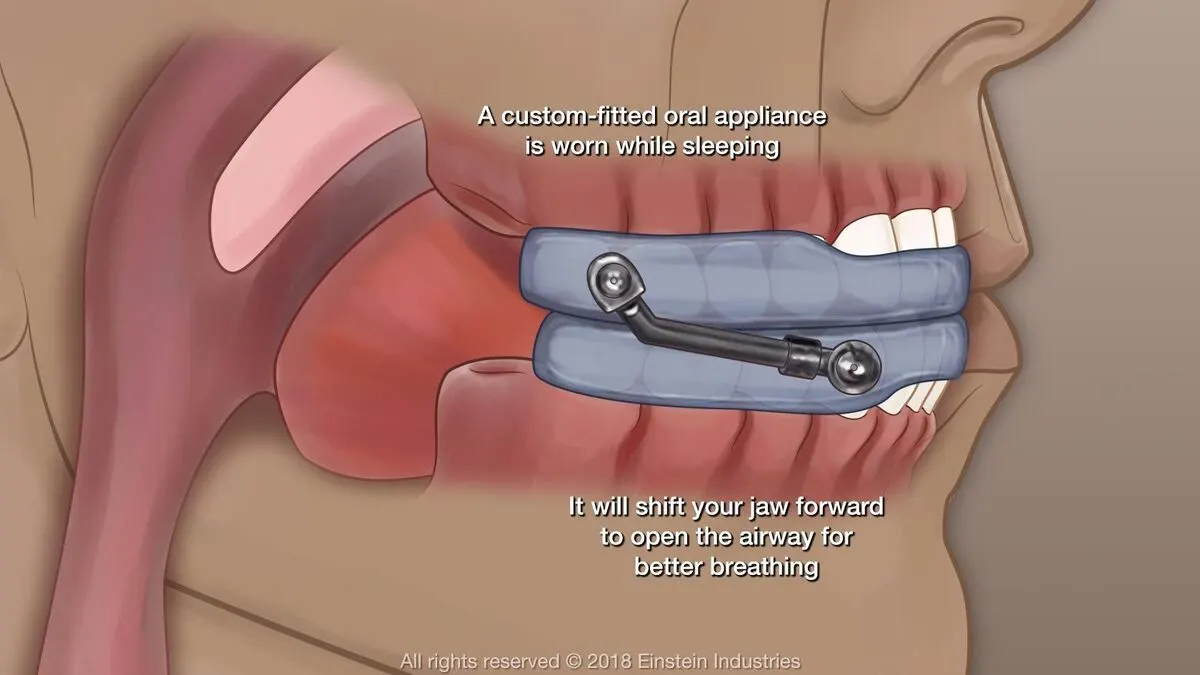
What an oral appliance is
A mandibular advancement device is a custom-made dental appliance worn at night that holds the lower jaw slightly forward, increasing the space behind the tongue. It is fitted by a dentist with training in dental sleep medicine, on a prescription from a sleep physician.
Two professional bodies, two different positions
You will find confident and contradictory claims about where oral appliances sit relative to CPAP. That is because the sleep medicine and dental sleep medicine academies do not currently say the same thing, and we would rather show you both than pick the one that suits us.
The joint 2015 clinical practice guideline
The guideline is a joint document of the American Academy of Sleep Medicine and the American Academy of Dental Sleep Medicine, and both academies still cite it. It says:
- Sleep physicians should prescribe oral appliances for adults with obstructive sleep apnea who are intolerant of CPAP or who prefer an alternative. This is a standard-level recommendation.
- Patient preference between the two should be considered before therapy is prescribed.
- CPAP produces a greater reduction in breathing events and better oxygenation. Oral appliances remain an effective alternative when CPAP is not being used.
- A custom, titratable appliance is recommended over a non-custom boil-and-bite device.
- Follow-up involves both the sleep physician and the dentist, with repeat testing to confirm the appliance is actually working, and management of side effects such as bite change, jaw joint symptoms and tooth movement.
- For tongue-retaining devices, the evidence was insufficient to assess efficacy.
What that guideline does not say is that oral appliances are equivalent first-line therapy to CPAP for everyone with sleep apnea.
The AADSM position papers
In 2019 the American Academy of Dental Sleep Medicine published a position arguing that oral appliance therapy should be reimbursed as a first-line therapy for obstructive sleep apnea, on the grounds that preference and adherence affect real-world effectiveness and that requiring a failed CPAP trial first delays care.
A separate paper in the same issue argues the narrower case that payers should cover the therapy after documented CPAP intolerance. These are two different asks and they are frequently collapsed into one.
It is worth being precise about what kind of claim this is. The 2019 documents are position papers about payer sequencing. They are not a replacement clinical practice guideline, and they do not overturn the finding that CPAP reduces breathing events more.
For snoring without apnea
Where a sleep physician has diagnosed primary snoring, meaning snoring with apnea excluded, the same 2015 guideline gives a standard-level recommendation for oral appliances rather than no treatment, on high-quality evidence for reducing snoring.
Two caveats come with it. The diagnosis of primary snoring must be made by a sleep physician rather than a dentist, because snoring frequently accompanies apnea and getting that wrong has real consequences. And the evidence was insufficient to show that treating simple snoring with an appliance improves health outcomes beyond the snoring itself, sleep quality and your bed partner’s quality of life.
How this practice approaches it
Diagnosis first, then the conversation about which treatment, then a referral to a qualified dentist if an appliance is the right route, then repeat testing to confirm it is working. The repeat test is not optional: an appliance that quietens the snoring without controlling the apnea is the worst of both outcomes.
Been told an appliance is the answer, by someone selling appliances?
Worth a second opinion from someone who does not fit them. The diagnosis has to come first either way.
Call (614) 898-9340Sources
- Ramar K et al. Clinical practice guideline for the treatment of obstructive sleep apnea and snoring with oral appliance therapy: an update for 2015. A joint AASM and AADSM guideline. J Clin Sleep Med 2015;11(7):773–827. https://pmc.ncbi.nlm.nih.gov/articles/PMC4481062/
- AADSM position: oral appliance therapy should be reimbursed as first-line therapy for OSA. J Dent Sleep Med 2019;6(1). https://aadsm.org/journal/special_article_2_issue_61.php
- AADSM: coverage of oral appliance therapy after CPAP intolerance. J Dent Sleep Med 2019;6(1). https://aadsm.org/journal/special_article_1_issue_61.php